Basil Hallward
Basil Hallward is the artist who paints the portrait of Dorian Gray, a work that becomes the supernatural fulcrum of the novel. A painter of extraordinary talent, Hallward is introduced in the opening scene of the book, putting the finishing touches on a full-length portrait of a young man of extraordinary personal beauty. He is a man of deep feeling and artistic integrity, whose sudden disappearance some years after the events of the story caused, at the time, such public excitement and gave rise to so many strange conjectures. His role is that of the creator whose creation becomes the instrument of his own destruction and the mirror of another's soul.
Identity and Artistic Vocation
Basil Hallward is a painter of considerable skill and reputation, whose work has been chattered about in the penny newspapers. He is a graduate of Oxford, where his odd habit of tossing his head back used to make his friends laugh. He is described as having a rugged strong face and coal-black hair, a physical contrast to the ivory-and-rose-leaf beauty of Dorian Gray. Hallward is deeply devoted to his art, which he considers the highest calling. He believes that an artist should create beautiful things but should put nothing of his own life into them, and he laments that the age treats art as if it were meant to be a form of autobiography. He is determined to show the world what the abstract sense of beauty is, and for that reason, he initially resolves that the world shall never see his portrait of Dorian Gray. He is a man of principles, prejudices, and common sense, which Lord Henry Wotton observes is the consequence of putting everything charming into his work, leaving nothing for life.
Meeting Dorian Gray and the Birth of the Portrait
Hallward's life is irrevocably altered when he meets Dorian Gray at a crush at Lady Brandon's. Two months before the novel opens, he felt a curious instinct of terror upon seeing Dorian, knowing that he had come face to face with someone whose mere personality was so fascinating that it would absorb his whole nature, his whole soul, and his very art itself. He struggled to leave the room, but was detained by Lady Brandon and eventually introduced. From that moment, Dorian becomes the central figure in Hallward's life and art. He sees Dorian every day, and the young man's personality suggests to him an entirely new manner in art, an entirely new mode of style. Hallward declares that Dorian is all his art to him now, and that the merely visible presence of the lad unconsciously defines for him the lines of a fresh school, one that combines all the passion of the romantic spirit with all the perfection of the Greek spirit. The portrait he paints is his masterpiece, and he knows it as it stands.
The Confession of His Secret
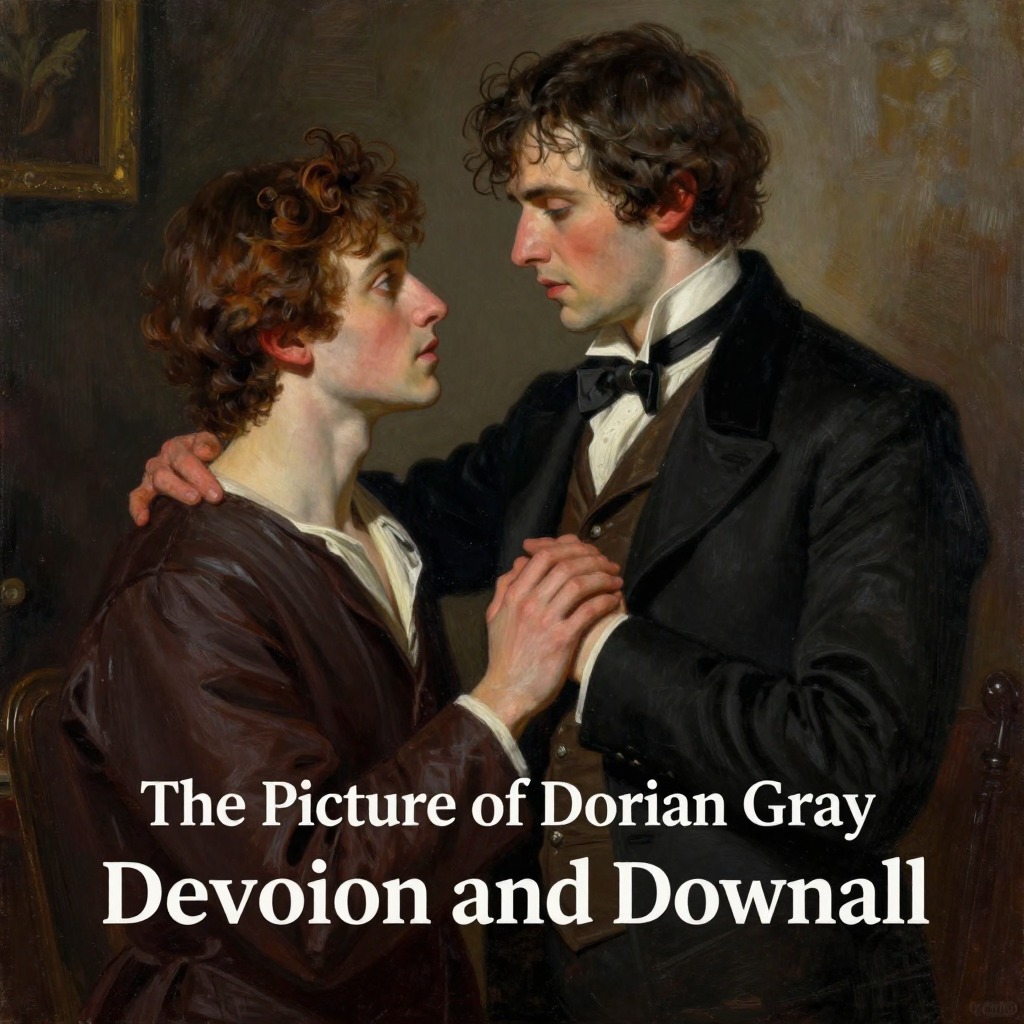
Hallward's devotion to Dorian is not merely artistic; it is a deeply personal, romantic idolatry. He confesses to Lord Henry that he has put too much of himself into the portrait, and that he is afraid he has shown with it the secret of his own soul. He admits that he worships Dorian, and that he finds a strange pleasure in saying things to him that he knows he will be sorry for having said. He gives himself away. Later, in a tense scene in Dorian's library, Hallward reveals the full extent of his feelings. He admits that he has worshipped Dorian with far more romance of feeling than a man usually gives to a friend, that he has never loved a woman, and that from the moment they met, Dorian's personality had the most extraordinary influence over him. He confesses to having adored him madly, extravagantly, absurdly, and to being jealous of everyone to whom Dorian spoke. This confession, which Hallward makes with great pain, is the secret he had hidden behind his refusal to exhibit the portrait. Dorian, who has his own terrible secret, uses this confession to deflect Hallward's questions about the portrait's change.
The Confrontation and Murder
Years later, on the eve of Dorian's thirty-second birthday, Hallward confronts him about the dreadful rumors circulating in London. He tells Dorian that his reputation is infamous, that he is said to corrupt everyone he becomes intimate with, and that his friendship is fateful to young men. He mentions the suicide of a boy in the Guards, the ruined career of Sir Henry Ashton, the dreadful end of Adrian Singleton, and the broken life of Lord Kent's only son. Hallward, who cannot believe these things when he sees Dorian's pure, bright, innocent face, demands an answer. In a moment of pride and madness, Dorian decides to show Hallward his soul. He leads him to the locked room at the top of the house and reveals the hideous, aged, and leering portrait. Hallward is horrified, recognizing his own brushwork and frame. He urges Dorian to pray, to repent, but Dorian is seized by an uncontrollable feeling of hatred. He seizes a knife, rushes at Hallward, and stabs him repeatedly behind the ear, killing him. The murder is swift and brutal, and Dorian feels strangely calm afterward.
Aftermath and Thematic Significance
After the murder, Dorian blackmails his former friend Alan Campbell into destroying the body using chemicals, leaving no trace. Hallward's disappearance becomes a topic of public discussion, but his body is never found. He is last seen alive leaving Dorian's house at eleven o'clock on the night of November 7th, supposedly to catch the midnight train to Paris, but he never arrives. Hallward's role in the novel is that of the moral conscience and the tragic victim. He is the creator whose love for his creation and his subject leads to his own destruction. His artistic integrity and his romantic, almost worshipful devotion to Dorian stand in stark contrast to Lord Henry's cynical, detached manipulation. Hallward's murder is the irreversible crime that seals Dorian's fate, and his portrait, the masterpiece that was meant to be a testament to beauty, becomes the record of Dorian's corruption and the instrument of his final destruction.